 Loading...

Insta360 X3 Beginner’s Tutorial: How To Get Started
TOP CREATIVE Videos with INSTA360 X3
Introducing Insta360 Ace Pro and Ace – Capture Action Smarter
insta360 X3 vs GoPro 11 – No One Tells You About THIS
The Ultimate Pocket Camera: Insta360 X3!
Introducing Insta360 GO 3 – The Tiny Mighty Action Cam
Introducing Insta360 X3 – Magic in Action
Grass 101: How It Works
Grass 101: How It Works
With thanks to Grass > Earn a Stake in the AI Revolution. Get Paid for Your Unused Internet
If you’re reading this blog post, you’ve probably heard about Grass, the flagship product from Wynd Network. Grass is an upcoming browser extension that lets users monetize their internet connection by selling unused network resources — by selling their “view of the internet.” But what exactly are these network resources, and what does “your view of the internet” mean?
Think of it like this: Grass enables you to sell a product you didn’t even know you have. Today we’ll explain exactly what that product is.
First, we’ll discuss why your internet connection is valuable, and why other people are willing to pay for it.
Then we’ll look at how the market for these resources works today, and how centralized proxy providers are already selling your network space without paying you for it at all.
Finally, we’ll introduce Grass: a decentralized residential proxy market that uses token rewards to upend the traditional business model for these networks and compensate its users fairly.
Grass has the potential to revolutionize this industry and create a more equitable, secure, and ethical marketplace for network resources. So let’s take a closer look and see how it all works.
1. Defining Residential IP Proxies
It all revolves around data.
Say there’s an airline who wants to know what all of their competitors are charging for plane tickets. This data exists on public websites, but how can they gather it all, particularly when it could vary based on the location of the viewer?
Or what if the same company paid for web advertising, and they want to see if their ads are showing up in all of the markets they paid to target?
To capture this information from the public web, they need to access the internet from the public’s point of view — from as many sources as possible, in as many locations as possible.
Every time you access the internet, you do it from a unique IP address, and a lot of what you see is tailored to your location. When you act as a residential IP proxy, it simply means that someone routes their internet traffic through your IP address, so they see the internet from your point of view. Then, they can use this view to scrape the web for whatever public data they may need.
What does this look like in real terms?
It looks like sharing your internet connection with someone else. Say you pay for a connection with a maximum download speed of 100 MB/s. If you’re only using 30 MB/s to download a file, that leaves 70 MB/s of “idle” bandwidth that isn’t being used at that moment. This is the bandwidth that companies will use to scrape the web from your IP address, and this is the resource you are already giving away, without knowing it.
As tends to be the case with big data, this might not seem like much at first. How much would someone possibly pay to check a website from your IP address? Yet these numbers add up, as companies scrape ever more massive amounts of data in the name of market research each year. So if the acquisition of public web data is only becoming a larger and larger part of the business world, why are none of us seeing any rewards when our internet connections are the ones facilitating it?
2. The Residential Proxy Market Today
Today, the market for residential IP proxies is dominated by a small number of highly centralized service providers. These companies function by creating massive proxy networks using residential IPs from all over the world, then selling their unused bandwidth to buyers like our airline from above. Typically, these networks will have a list of authenticated IP addresses that are whitelisted to be used by purchasers. Unfortunately, this is where the arrangement stops being fair to all parties.
In the best case scenario, the addresses on this whitelist are added with the full consent of their owners. Permission is granted in exchange for some type of payment, and residential internet users can voluntarily sign up to sell their network resources (the unused bandwidth from the residential internet connection tied to their IP address.)
Here’s the thing: even when residential internet users consent to participation, and even when they are compensated for their resources, the network is incentivized to pay them as little as possible to maximize their own profits. There’s very little competition to provide these proxy networks, and buyers and sellers have no possible way of connecting outside of them. Thus, the networks dictate the terms by which buyers and sellers engage with each other, universally deciding to charge buyers as much as possible and pay sellers as little as possible.
In the worst case scenario, everyday internet users like yourself are cut out of the equation entirely. Whether you know it or not, many of the free apps you download have lines in their terms and conditions that sign you up to donate your unused bandwidth to proxy networks. This may help developers to monetize their products, and help proxy companies to recruit unwitting internet users, but you can bet that you’ll never see a penny of the proceeds.
The end result? You are paying for a certain amount of bandwidth, and then when you don’t use it all, your ISP doesn’t refund the money. Instead, it is sold to someone else, and they don’t even cut you in on the deal!
Obviously it’s not unfair to say that the existing landscape of the residential proxy industry falls somewhere between vaguely exploitative and outright unethical. But what can be done to address these problems and put network resources back in the hands of their rightful owners?
3. Introducing Grass
Simply put, Grass is a decentralized alternative to the networks described above. It is a network sharing application that allows users to sell their unused bandwidth. Where existing networks are operated by exploitative middlemen who extract value from the parties exchanging resources, Grass is an equitable solution in which both sides have an active stake in the network.
To individuals, it will appear as a web extension that is downloaded, left on, and forgotten about. It will do its work behind the scenes, helping others to acquire public web data in exchange for payment in the protocol’s native token.
Through this token, two things will happen. One, tokenholders will accrue a portion of the fees collected by the network. Two, it will function as a governance token, allowing users to vote on important decisions about the direction of the protocol. By this system, individuals who were disenfranchised and exploited by centralized proxy networks will be given a stake and a say in the Wynd network.
Compared to its centralized counterparts, Grass is:
- Ethical. These resources are already being sold out from under you, so Grass simply transfers the proceeds to their rightful owners.
- Democratic. By paying in tokens, Grass doesn’t just compensate you for your unused network resources — it compensates you with ownership of the network itself.
- Secure. There is an inherent danger in having a small number of companies control this infrastructure, which is mitigated by decentralization.
Ultimately, Grass takes a more principled approach to this industry than the bad actors who lead the pack today. Like many use cases of blockchain technology, it creates a more equitable distribution of resources by doing away with the centralized control of networks, making the world more fair in the process.
We’ll be releasing more details about the network over the next few months, and beta will launch in June. So stay tuned for more information and sign up now for early access. Before long, your internet will be back in your hands, and we can all finally touch grass.
What is Grass? The Data Layer of AI
What is Grass? The Data Layer of AI
With thanks to Grass > Earn a Stake in the AI Revolution. Get Paid for Your Unused Internet
TL;DR: Grass is a decentralized network for accessing the public web, and thus accessing the data necessary to train AI models. As it expands into the business of cleaning and preparing structured datasets, it becomes an integral part of the basis for AI’s existence – the data layer of AI.
Introduction
Recently, you may have heard people refer to Grass as “The Data Layer of AI.” What does that mean, though?
You’re probably aware that the AI revolution is unfolding as we speak, and you may know that Grass is the easiest way to earn a stake in it while there’s still time. But anything more complicated than that, and – well, that’s when the headaches begin. The subject gets complicated fast, and there’s a lot of noise out there.
And that’s okay. Explaining this stuff is literally our job.
So today we’re going to go into a bit more detail about what the Data Layer of AI is, and explain some of the new services that Grass has started performing recently. Then you’ll have a clearer picture of why 600,000 people seem to think this is a good idea, and why you made the right choice by deciding to get on board. Let’s dive in.
- What is The Data Layer of AI?
What is the Data Layer of AI?
Well, before we even go there, what is AI in the first place? Explain like I’m 5.
Simply put, AI is a program that takes large amounts of data and finds patterns in it. Then, it uses these patterns to make predictions when prompted.
One example: Think of ChatGPT. It takes billions of words and it notices how they each correlate with one another. It sees the word “sky” next to the word “blue” 10 or 15,000 times, and now it can tell you: the sky is blue.
Okay, now pause.
You’ll notice that three things happened in that paragraph.
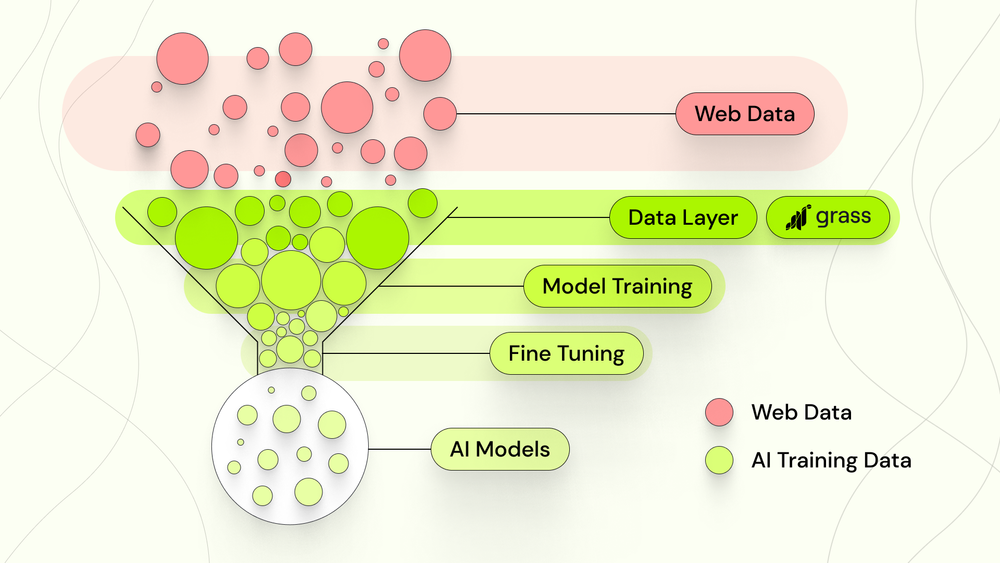
First, the model acquired the data to be trained on. Second, it combed through it to “learn” all the patterns and correlations it could find. And third, it told you “blue” when you asked what color the sky was.
When you think of an AI protocol, particularly in crypto, you probably think of part two – the training. You think of a decentralized network of processors that the model uses when it combs through data, hunting for patterns. And you’d be right – that’s one kind of AI protocol. The thing is, it’s not the most important part. This next part is, though, so read closely.
While training an AI model is obviously important, the answers you get when you use it are based solely on the correlations it finds in the training data. ChatGPT can tell you the sky is blue only because it encountered that answer enough times in the data it was trained on. If you start with low quality training data, you end up with low quality answers. No training data? No answers.
In other words, you can have the most powerful model on the planet, but if it was trained on two Medium articles that both say the sky is green, guess what your model will tell you when you ask what color the sky is. Bzzzt. Wrong answer.
When viewed in this way, the data is actually the most important part of any AI model. Far from being a perfunctory preamble to development, data is actually the core of any functioning model, and data provisioning is the basis for any training. That’s why, according to one report, “Preparing data for AI tools often accounts for up to 80 percent of the total workload involved in implementing AI systems.” Data provisioning is actually most of the battle!
So what is the data layer, then?
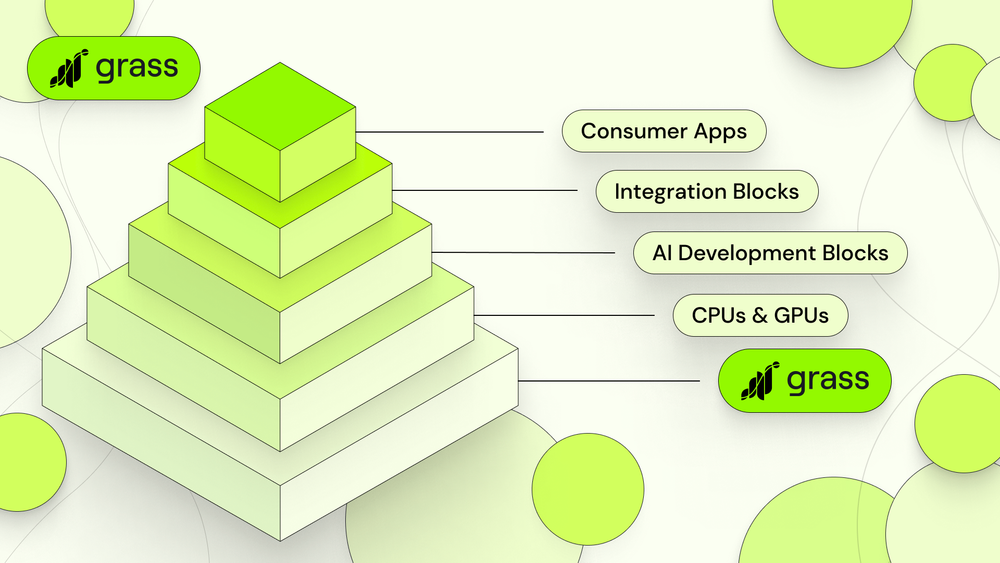
The data layer is that first stage of AI development. It’s the part of the AI stack where data is gathered and prepared for a model, before training even begins. And this, my friends, is Grass. It’s also where you can contribute, and where you can reap some of the benefits of the cambrian explosion of artificial intelligence. So do stay with us. Let’s continue…
- Is Grass used to acquire data for AI training?
We’re glad you asked. Yes, that’s exactly what Grass is used for!
When you run a node on Grass, you’re selling the portions of your internet connection that aren’t in use. We’re not all streaming video 24 hours a day, so there’s plenty of internet that you pay for, but aren’t using at any given time.
And this is a resource that AI labs will pay for! Using our network, they can go online to view public websites and scrape AI data. This is then used for training purposes, creating tomorrow’s AI models and compensating ordinary people for a change. It’s really that simple.
- Is Grass used to prepare this data after it’s gathered from the internet?
Thanks to Socrates, our new, in-house vertical for AI development, indeed it is.
When data is scraped from public websites, it arrives unstructured. Picture the language data from a website, only instead of sentences and paragraphs, you see only a string of letters and numbers, thousands of digits long, with no comprehensible order. Structuring data refers to the process of taking these numbers and putting them into a recognizable format – in this example, organizing them so they can actually be read and interpreted. Data needs to be structured in a specific way for an AI model to use it, so this is obviously a critical step in the AI pipeline.
Another component of preparation is cleaning the data. Outliers may skew the results that a model comes up with when it’s learning, so it’s important to throw those out before training begins. Moreover, we’re starting to see more instances of intentional poisoning as the data wars heat up and companies attempt to sabotage each other. They accomplish this by including deliberately false information on their websites, to stymie their opponents when they attempt to scrape each other for corporate intelligence. This is one more reason why data can’t simply be plugged into AI models without careful preparation first.
Socrates began as a large data repository, to which AI labs could request access specifically for the purpose of training LLMs. Currently, however, work is underway on training a model of its own, to be used in automating the process of scraping and data preparation, as well as tagging data after it’s been scraped. This will really kick the data layer into overdrive, accelerating the advancement of decentralized AI across the board.
- Why is a decentralized network necessary to perform these services?
Many of the largest websites in existence have a stake in private, centralized AI companies and a vested interest in preventing smaller competitors from gaining a foothold. Even the ones that don’t have still begun to realize how much their data is worth, and they’ve started instituting policies that make access cost prohibitive for all but the largest AI labs. A huge amount of language data can be drawn from Reddit, for example, but the company began charging exorbitant amounts for their API last year, and now attempts to stop people from scraping it themselves.
In practice, this often works by blocking the IP addresses of known data centers. Many corporations run networks like Grass that are centralized and extractive compared to Grass’s decentralized and equitable design, and these networks often rely on data centers for scraping. Since websites block these IP addresses, the only real way an AI lab can view them is through decentralized networks like Grass.
- How is Grass better than traditional methods of data provisioning?
Grass was built for one reason: because the rise of AI is an opportunity to right some of the wrongs that occurred in Web 2.0. We are unhappy with the way the internet is developing right now, and we believe that building this infrastructure is the best way to promote our values in the development of Web3.
Here are three things we’re proud of:
- Grass is a network that will be owned and operated by its users. When you run a node and earn Grass points, you’re earning a stake in the network itself as you help operate it. Unlike other networks, who incentivize their users with a pittance if they incentivize them at all, Grass is designed to be an equitable and collective project. That means that as AI grows, we all benefit instead of just Bill Gates and Elon Musk.
- Grass is the single easiest way that currently exists for anyone to get exposure to the rise of AI. Running a node is as easy as signing up and installing the Chrome extension, and the app does the rest of the work for you. Grass is a passive, rather than active way to participate in AI, meaning anyone can contribute with virtually no effort.
- In addition to its usefulness in training conventional artificial intelligence, Grass is enabling the creation of decentralized and open-source AI by creating alternative pathways for web data to be accessed. If nobody does this, companies like Google and Microsoft will be empowered to gatekeep the public web, as the only entities who have indexed the whole thing. They can then use this power to assert a monopoly on the development of AI, since (as you now know) no training data = no AI model. By providing this service and creating the rails for structuring data as Socrates is, Grass is working to make public web data accessible to all.
This was a lot of information, but hopefully you have a better sense of the role Grass plays in AI development, what our current mission is, and why we feel it’s so important. By participating with us here, you’re not just earning compensation for the work you do building the network. You’re helping to create a better, fairer, and more just world. Like AI itself, it all begins with the data layer. So thanks for helping us build this infrastructure and create the world we want to live in.
Automated GoPro Video Editing Turns Amateur Athletes into Heroes
Algorithmic Video Editor Turns Amateur Athletes into GoPro Video Editing Heroes…
Automated video and sound editing software can make any bumbling idiot into an extreme sports movie star. Improvements to mobile devices and digital cameras have made it easier to capture video, but editing footage still requires significant expertise and time.
Visit any surf break, mountain bike trail, or ski resort and you’ll see people diligently filming their best moves, worst falls, and a lot of tedium in between using smartphones and action cameras such as a GoPro. Startup Shred Video has developed technology that tries to edit collections of such footage into short, slick, and shareable movies at the push of a button. The company’s software uses algorithms that analyse and edit or remix video and music to try and make short movies in the style of those produced by extreme sports brands to show off the exploits of their sponsored athletes. The final results are generally two minutes long or less. The company’s software is available to download for Apple computers.
Shred CEO Mike Allen says the company wants to be something like the video equivalent of Instagram, which by providing photo filters made it easy for anyone to make their mobile snaps more interesting to other people. However, because producing video is more complex, Shred has had to develop more sophisticated technology, he says. “It takes more than a sepia filter to make video great, it takes curation, pacing, synchronized audio and video,” said Allen, launching his company at an event held by the YCombinator accelerator program on Wednesday. Software isn’t capable of creative decisions, but Allen says the relatively formulaic structure of extreme sports videos is within its grasp.
Shred’s software sets out to make movies that begin with slow moving, establishing shots, for example showing the beach or ski slope at the start of a trip; transition to highlights of the adrenaline pumping action; and then wind down with more shots of scenery and people at the end. “That formula still works even though you’re not doing the most extreme backflips,” says Allen. The software selects footage to use by looking at time stamps and the pattern of acceleration in the frame. It can also shorten and remix any song provided by the user, using algorithms that can identify and edit the different musical parts of a track. The software aims to play the intro to a song during the establishing footage, and then switch to the chorus or a more up tempo section just as the action begins. Cuts between clips are all made on the beat. Last year, users of Facebook and Google’s social network, Google+, were offered automatically generated “year in review” movies combining both photos and video. They used music but didn’t let you choose it, and didn’t appear to remix it to fit the visuals.
Google’s Photos service automatically creates movies for, say, vacations and allows you to choose from a menu of music and some visual filters, but it is not focused on action footage. Allen concedes that his more ambitious software doesn’t always get it right the first time, but says that it makes it easy enough to provide quick feedback—for example to include or leave out some footage. A slick 2.5-minute video Allen made of a surf trip with friends took less than five minutes of work to produce from a collection of more than six gigabytes of raw footage, he says.
See all stories on this topic
Watch: GoPro Camera Meets Hungry Russian Bear
You know how in horror movies they sometimes find videos that preview horrifying encounters but that end just before they get to the best part and so you don’t really know what happened to the screaming and kicking victim? Well, this just about sums up the footage below. The video, posted online by the Russian Geographical Society just a couple of days ago, documents a close encounter between a GoPro camera and a terribly hungry bear. Needless to say, the camera is the victim and the bear the assailant.
Apparently, wildlife researchers with the Society planted the camera on the bank of a lake in the South Kamchatka Sanctuary hoping to spy on bears fishing in the area. Unfortunately, one of the animals spotted it and decided to investigate / eat it. The footage starts with the bear running towards the camera. Then there’s a close-up view of the inside of the animal’s mouth, sharp teeth and all, after which everything goes dark. We can only assume a bite was all it took to destroy the camera. Then again, maybe the bear simply picked it up and turned it off, annoyed at the thought that somebody was trying to spy on him, possibly even steal his fishing techniques. After all, bears are terribly talented at catching fish and so it makes sense that some folks would very much like to learn their tricks….
See all stories on this topic
When Is The New GoPro Coming Out?
GoPro Hero 5, Half the Weight and Size of Hero 4?
The GoPro Hero 5 was supposed to come out in October this year but the American camcorder company based in San Mateo, California has decided to push it back to next year, claiming that it plans to incorporate more new ground-breaking features to the device to officially make it the most powerful videography equipment in the world when it comes out in 2016.
Apparently, it was also a market strategy for GoPro as the company unveiled its GoPro Hero LCD in June followed by the GoPro Hero 4 Session last month, details the Christian Post. The GoPro Hero 4 Session is petite and shaped like a tiny transparent cube featuring miniature circuit boards in a very tiny assembly, describes the Day Herald. The unit is said to be waterproof and it has various elements that are carefully arranged so that the GoPro Hero 4 Session can produce awesome wide-angle videos.
According to GoPro, the GoPro Hero 4 Session is 50% smaller and 40% lighter than its predecessor GoPro Hero 4 models.
It seems that GoPro is looking to make its future devices smaller and smaller and word has it that GoPro Hero 5 will also come out at only 50% of the weight and size of GoPro Hero 4. This means that GoPro Hero 5 will approximate the size and weight of the GoPro Hero 4 Session. As to what would be the major physical differences, it would be up for people to really find out when the device is officially released to the market next year.
But based on its reported features and specifications, the GoPro Hero 5 will be like no other action cameras that GoPro or any other manufacturer has come up with. Most powerful action camera ever GoPro Hero 5 is reportedly set to take the mantle as the world’s most powerful videography equipment when it finally launches early next year. The official release date of the action camera was pushed back to next year in order to allow for unprecedented upgrades to the device. Apparently, GoPro wants to live up to the hype that the Hero 5 has established since late last year. The company wants the device to become the best action camera that it has come up with upon its roll out by next year.
While others may think of it as a lofty ambition, it is actually a major goal for GoPro because the company is optimistic that it can meet consumer expectations given its credentials with the launch of the ground-breaking GoPro Hero camcorders in the past couple of years. As has previously been reported, the delay in the launch in the latest action camera from GoPro is to buy the company some time to incorporate more new technologies to the device and make it really the best there is when it comes out in the retail markets next year.
The GoPro Hero 5 is reportedly waterproof and is said to be functional underwater up to a depth of 60 meters, which would enable it to deliver better underwater recording capabilities no other videography equipment out in the market today can match.
Cheaper than GoPro Hero 4?
If latest rumors are true that the GoPro Hero 5 will come out with a price cheaper than its predecessor, then the American camcorder manufacturing company will also be ushering a ground-breaking strategy that has never been employed by anybody in the market before. It has always been the norm in the tech industry that whenever a new device comes out of the market, it is normally priced higher than its predecessor. That is quite understandable considering the upgrades and improvements that manufacturers usually include into the latest models of their devices compared to the ones they have succeeded.